
EU AI Act: Organisational Readiness, Risks, Best Practices and Future Trends
The EU Artificial Intelligence Act is the world’s first comprehensive legal framework governing artificial intelligence and introduces a risk-based regulatory approach to ensure that AI systems are developed and used in a safe, transparent, and trustworthy manner.
The legislation classifies AI applications into different risk categories, ranging from minimal risk to unacceptable risk, with corresponding obligations for providers, deployers, importers, and distributors. High-risk AI systems, such as those used in critical infrastructure, employment, education, law enforcement, and essential public services, are subject to stringent requirements relating to risk management, data quality, human oversight, transparency, cybersecurity, and ongoing monitoring.
The Act also prohibits certain AI practices considered to pose an unacceptable risk to fundamental rights and public safety, while establishing governance, enforcement, and compliance mechanisms to support responsible innovation and protect individuals across the European Union. It applies to organisations that develop, provide, import, distribute or deploy AI systems in the EU market, including non-EU organisations where AI outputs affect people in the EU.
The Act aims to promote trustworthy, human-centric AI while protecting health, safety, fundamental rights, democracy, rule of law and the environment. It uses a tiered risk model including prohibited AI practices, high-risk AI systems, limited-risk systems subject to transparency requirements, and minimal-risk systems with limited regulatory obligations.
|
Risk Category |
Examples | Organisational Implication |
| Unacceptable Risk | Social scoring, manipulative AI, certain biometric categorisation and prohibited workplace emotion recognition use cases | Use is banned; organisations must identify and discontinue any prohibited practices. |
| High Risk | AI used in recruitment, worker management, education, credit scoring, critical infrastructure, healthcare and regulated products | Requires strong governance, risk management, data quality, human oversight, conformity assessment & monitoring. |
| Limited Risk | Chatbots, synthetic content and certain generative AI interactions | Requires transparency so users know they are interacting with AI or AI-generated content. |
| Minimal Risk | Spam filters, recommendation tools and low-impact automation | Generally permitted, but voluntary responsible AI controls remain advisable. |
Regulatory Expectations from Organizations –
The European Union Artificial Intelligence Act (EU AI Act) represents world’s first comprehensive legal framework governing the development, deployment, procurement and use of AI systems.
The regulation introduces a risk-based approach and places significant responsibilities on organizations that develop, provide, deploy, or use AI systems within the European Union. As regulatory scrutiny increases, organizations must proactively establish governance frameworks, compliance controls, and risk management processes to ensure alignment with evolving legal and ethical requirements.
Regulators increasingly expect organizations to demonstrate proactive compliance rather than reactive remediation.
Key Regulatory expectations include:

- Data Governance: Robust data governance, privacy protection, and cybersecurity controls.
- Transparency: Transparency, explainability, and appropriate disclosure of AI usage.
- Human oversight: Human oversight for high-risk AI applications and critical decision-making processes.
- Testing and Monitoring: Regular testing, validation, and performance monitoring of AI systems.
- Vendor Risk Management: Vendor and third-party risk management for externally sourced AI solutions.
- Training & Awareness: Training & Awareness to protect fundamental rights, fairness, non-discrimination and managing the AI adoption effectively.
Organisational Readiness and key Risks faced during AI Adoption:
Organizations should begin by conducting a comprehensive inventory of all AI systems currently in use or under development. This includes internally developed models, third-party AI solutions, embedded AI capabilities within enterprise software, and generative AI tools used by employees.
A detailed classification of AI systems against the EU AI Act’s risk categories, unacceptable risk, high-risk, limited-risk, and minimal-risk is essential to determine applicable compliance obligations. A robust AI governance framework should be established with clear accountability structures.
Organizations are expected to define roles and responsibilities across business units, technology teams, legal, compliance, risk management, cybersecurity and executive leadership. Governance bodies should oversee AI strategy, risk assessment, regulatory compliance, model monitoring & ethical decision-making.
Organizations must also integrate AI risk management into existing enterprise risk management programs. This includes establishing policies for data governance, model development, validation, testing, monitoring, incident management, documentation, and auditability. Employee awareness and training programs are critical to ensure responsible AI usage across the organization.
Some of the Key Risks that Organizations face during AI adoption:
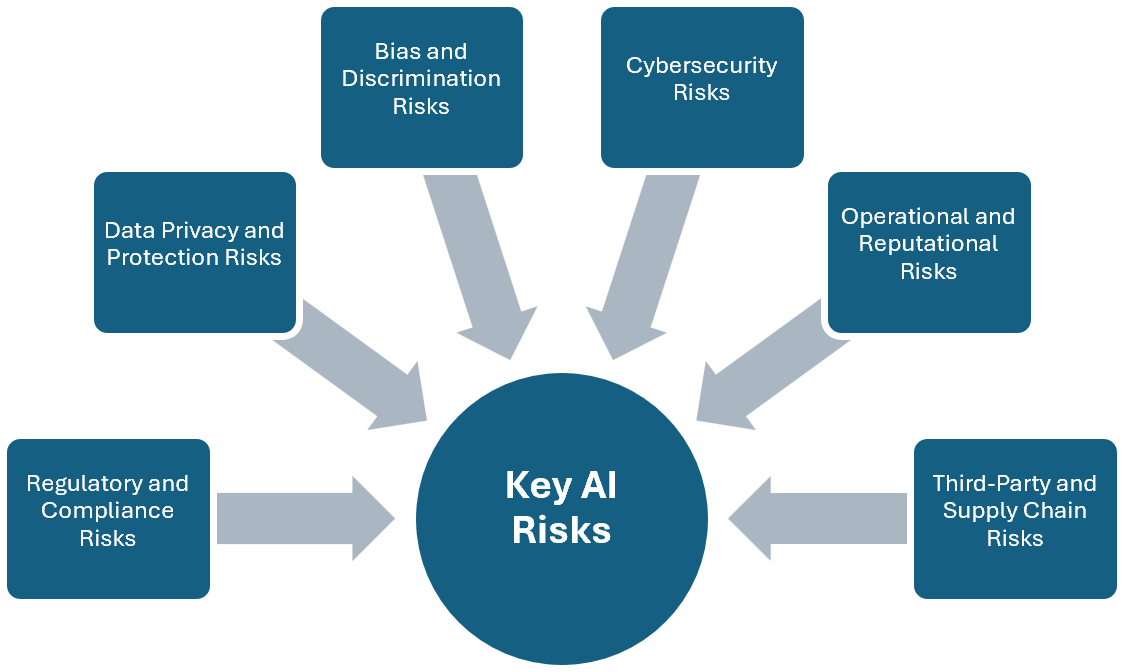
Regulatory and Compliance Risks:
Non-compliance with the EU AI Act can result in significant financial penalties, regulatory investigations, operational restrictions, and reputational damage. Organizations may face substantial fines depending on the severity of violations.
Data Privacy and Protection Risks:
AI systems frequently rely on large volumes of personal and sensitive data Organizations must ensure compliance with GDPR and other applicable privacy regulations, including lawful processing, transparency, data minimization, and protection of individual rights.
Bias and Discrimination Risks:
Poor-quality data, inadequate model design, or insufficient oversight can result in discriminatory outcomes affecting individuals and groups. Bias-related incidents may lead to legal liabilities, regulatory scrutiny, and loss of stakeholder trust.
Cybersecurity Risks:
AI systems introduce new attack surfaces, including adversarial attacks, model manipulation, data poisoning, prompt injection, and unauthorized access to AI-generated outputs. Organizations must implement strong security controls throughout the AI lifecycle.
Operational and Reputational Risks:
Inaccurate, unreliable, or harmful AI outputs may disrupt business operations, create customer dissatisfaction, and damage organizational reputation. Over-reliance on automated decision-making without adequate human oversight may further amplify these risks.
Third-Party and Supply Chain Risks:
Organizations remain accountable for AI systems sourced from external vendors. Vendor due diligence, contractual safeguard and continuous monitoring are essential to ensure compliance and risk management.
Best Practices for Compliance and Responsible AI:
Organizations that establish mature AI governance, risk management, and compliance capabilities early will be better positioned to meet regulatory expectations, build stakeholder trust, enable responsible innovation, and achieve sustainable adoption of AI technologies in an increasingly regulated environment.
Some of the Industry best Practices for the Organisations:
Regulatory and Compliance Risks:
Non-compliance with the EU AI Act can result in significant financial penalties, regulatory investigations, operational restrictions, and reputational damage. Organizations may face substantial fines depending on the severity of violations.
Data Privacy and Protection Risks:
AI systems frequently rely on large volumes of personal and sensitive data Organizations must ensure compliance with GDPR and other applicable privacy regulations, including lawful processing, transparency, data minimization, and protection of individual rights.
Bias and Discrimination Risks:
Poor-quality data, inadequate model design, or insufficient oversight can result in discriminatory outcomes affecting individuals and groups. Bias-related incidents may lead to legal liabilities, regulatory scrutiny, and loss of stakeholder trust.
Cybersecurity Risks:
AI systems introduce new attack surfaces, including adversarial attacks, model manipulation, data poisoning, prompt injection, and unauthorized access to AI-generated outputs. Organizations must implement strong security controls throughout the AI lifecycle.
Operational and Reputational Risks:
Inaccurate, unreliable, or harmful AI outputs may disrupt business operations, create customer dissatisfaction, and damage organizational reputation. Over-reliance on automated decision-making without adequate human oversight may further amplify these risks.
Third-Party and Supply Chain Risks:
Organizations remain accountable for AI systems sourced from external vendors. Vendor due diligence, contractual safeguard and continuous monitoring are essential to ensure compliance and risk management.
Best Practices for Compliance and Responsible AI:
Organizations that establish mature AI governance, risk management, and compliance capabilities early will be better positioned to meet regulatory expectations, build stakeholder trust, enable responsible innovation, and achieve sustainable adoption of AI technologies in an increasingly regulated environment.
Some of the Industry best Practices for the Organisations:
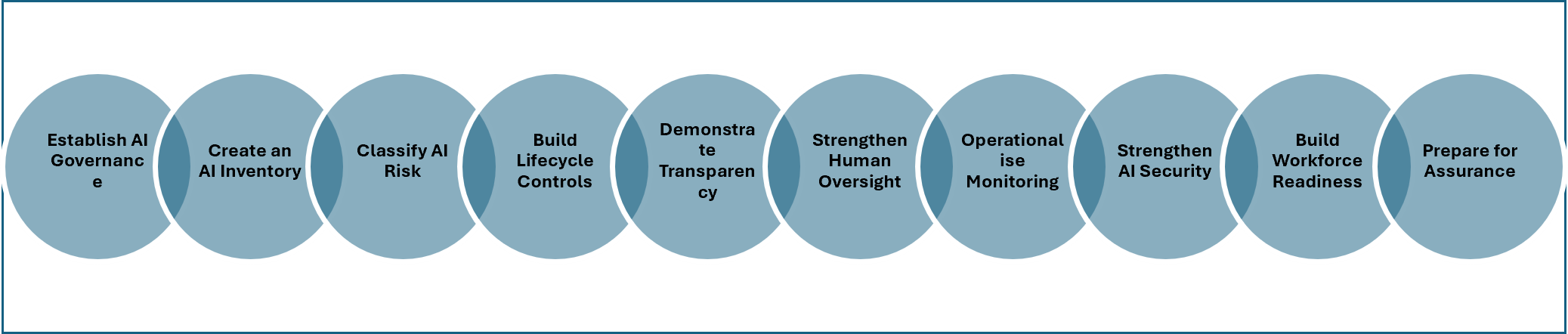
- Establish AI Governance: Define ownership across legal, risk, compliance, technology, data, security, procurement and business teams.
- Create an AI Inventory: Identify approved and shadow AI systems, vendors, use cases, models, datasets, owners and business processes impacted.
- Classify AI Risk: Map each AI system against EU AI Act risk categories and determine whether the organisation is acting as provider, deployer, importer or distributor.
- Build Lifecycle Controls: Embed governance from design and procurement through deployment, monitoring, incident response and retirement.
- Demonstrate Transparency: Inform users where AI is used, explain relevant AI-assisted decisions and label synthetic or AI-generated content where required.
- Strengthen Human Oversight: Ensure accountable human intervention is meaningful, trained and empowered to challenge AI outcomes.
- Operationalise Monitoring: Track model drift, accuracy, fairness, security events, user complaints, incidents and performance degradation.
- Strengthen AI Security: Apply secure development practices, adversarial testing, access controls, logging, red teaming and prompt-injection safeguards.
- Build Workforce Readiness: Deliver role-based AI literacy training for executives, product owners, developers, procurement teams, risk teams and end users.
- Prepare for Assurance: Conduct internal audits, readiness reviews and independent assessments before regulatory deadlines.
Organisations should treat EU AI Act readiness as a strategic governance programme rather than a narrow legal exercise. The priority is to create visibility of AI usage, classify risk, define accountability, strengthen data and security controls, evidence compliance and build a culture of responsible AI adoption. Early preparation will reduce regulatory exposure, improve trust and enable safer innovation at scale.
Name – Kavitha Srinivasulu
Company – TCS
Designation – Director Of Cyber Security & Data Privacy
About the Author: Senior cyber risk and resilience executive with over 20 years of global leadership experience advising Boards and Executive Committees across Financial Services, Healthcare, Retail, Technology, and regulated industries. Delivered and led large-scale, regulator-driven cybersecurity, AI driven, PCI, and SOC transformations for Tier-1 banks, global healthcare organisations, and highly regulated enterprises operating across the UK, EU, USA, APAC, and ANZ. Trusted advisor to Boards, C-suite, regulators, and global enterprises, consistently delivering resilient, compliant, and scalable cyber operating models.
Disclaimer: “The views and opinions expressed by Kavitha in this article are solely her own and do not represent the views of her company or her customers.”