
As organizations accelerate AI adoption to drive innovation, efficiency, and competitive advantage, they are also facing a rapidly evolving threat landscape. The integration of AI technologies introduces new security risks, from data leakage and model manipulation to adversarial attacks and governance challenges. Understanding these emerging threats is critical to ensuring that AI systems are deployed responsibly, securely, and in alignment with organizational risk management frameworks.
Across all the other Geos working towards adopting to AI, AI adoption in Europe Geo is accelerating but, at the same time cyber threats are becoming faster, more automated and more difficult to attribute. The European security landscape is now shaped by three converging forces like AI-enabled attacks, AI-enabled defence, and a fast-maturing regulatory environment led by the EU AI Act, NIS2, DORA, Cyber Resilience Act & ENISA guidelines.
Europe’s AI Security Landscape:
Europe is moving from experimental AI adoption to enterprise-wide deployment across financial services, healthcare, public administration, energy, manufacturing, insurance and digital infrastructure. This shift is increasing productivity and decision intelligence, but it also expands the attack surface across data pipelines, models, APIs, third-party platforms, cloud services and automated decision workflows.
AI is rapidly becoming a foundational capability across Europe’s public and private sectors, driving innovation, operational efficiency, and economic growth. At the same time, AI is introducing a new generation of cybersecurity, governance, and resilience challenges that are reshaping the region’s risk landscape. Key developments include the emergence of AI-enabled cyberattacks, increasingly sophisticated deepfake and disinformation campaigns, vulnerabilities within AI supply chains, and growing concerns around data privacy, model integrity, and critical infrastructure protection.
Threat actors are leveraging generative AI to accelerate reconnaissance, automate social engineering, enhance malware development, and scale attacks with unprecedented speed and precision.
Europe’s regulatory environment is evolving equally rapidly. The EU AI Act, NIS2 Directive, Digital Operational Resilience Act (DORA), GDPR, and sector-specific regulations are establishing one of the world’s most comprehensive governance frameworks for trustworthy and secure AI adoption. Organizations are expected to demonstrate transparency, accountability, risk management, security-by-design principles, and continuous oversight of AI systems throughout their lifecycle.
Emerging Threat Trends:
The most visible threats today include ransomware, AI-assisted phishing, credential theft, exploitation of newly disclosed vulnerabilities, supply-chain compromise, model manipulation, data leakage and misuse of generative AI tools. Threat actors are increasingly using AI to create convincing social engineering content, automate reconnaissance and accelerate vulnerability exploitation.
- AI-Generated Social Engineering – Phishing, business email compromise, deepfake voice and synthetic video are becoming more realistic, personalised and scalable.
- Faster Vulnerability Exploitation – AI can shorten the time between vulnerability disclosure and exploitation, increasing pressure on patch management and exposure monitoring.
- Model and Data Attacks – Data poisoning, prompt injection, model inversion, model theft and adversarial manipulation are emerging as key risks across the AI lifecycle.
- Autonomous Attack Tooling – Agentic AI can support reconnaissance, exploit chaining, malware adaptation and automated lateral movement.
- Third-Party and Supply-Chain Exposure – Organisations depend heavily on cloud AI services, open-source models, SaaS integrations and external data providers.
- Regulatory-Driven Extortion – Attackers may exploit fears of GDPR, DORA, NIS2 or AI Act penalties to intensify ransom pressure after data or model compromise.
Key Risks and Challenges:
Based on the evolving cybersecurity risks, regulatory and compliance challenges, data protection concerns, emerging threat vectors, and strategic mitigation priorities for Business Leaders across the Europe Geo!
| Risk Area | Why It Matters | Typical Challenge |
| Data Security | AI systems depend on large volumes of sensitive, regulated and business-critical data. | Preventing leakage, misuse, unauthorised training and cross-border transfer issues. |
| Model Security | Models can be attacked, manipulated, extracted or misused. | Securing prompts, outputs, fine-tuning data, APIs and model access controls. |
| Identity and Access | AI agents can act with delegated authority across systems. | Managing privileged access, service identities and human approval points. |
| Third-Party Risks | AI adoption often relies on vendors, cloud providers and open-source components. | Assessing contractual, operational, resilience and audit obligations. |
| Regulatory Compliance | Europe’s AI and cybersecurity rules are expanding quickly. | Mapping AI use cases to AI Act, GDPR, NIS2, DORA and sector rules. |
| Operational Resilience | AI failures can affect critical services, customer outcomes and business continuity. | Testing fallback processes, recovery plans and incident response playbooks. |
Implementation Models for a Secured AI Adoption:
European organisations are moving from AI experimentation to scaled adoption, but the operating environment is now defined by heightened regulatory, cyber, privacy and third-party risk expectations. Secure AI adoption in Europe requires a risk-based implementation model that aligns innovation with the EU AI Act, GDPR, NIS2, sector regulations and emerging assurance expectations. The priority for executive leadership is not simply to approve AI use cases, but to establish a repeatable governance and control model that enables safe, compliant and measurable AI deployment across the enterprise.
- Centralised AI Governance Model: A single enterprise AI governance board owns standards, risk acceptance, policy, tooling and assurance.
- Federated Business-led Model: Business units adopt AI with central guardrails, risk templates, control libraries and security review checkpoints.
- High-risk AI Control Model: AI use cases are classified by risk level, with enhanced controls for regulated, customer-impacting, safety-critical or rights-impacting systems.
- Secured AI Platform Model: Organisations provide approved AI platforms, secure APIs, monitored data connectors and enterprise-grade model access.
- AI Security-by-Design Model: Security, privacy, resilience and compliance requirements are embedded from ideation through development, deployment and monitoring.
Industry Best Practices:
European regulation will reshape AI adoption. The EU AI Act will drive risk classification, transparency, human oversight & cybersecurity expectations. NIS2 will raise the baseline for cybersecurity across essential and important sectors. DORA will continue to enforce operational resilience, including ICT risk management, third-party oversight & resilience testing. Together, these frameworks will make AI governance a board-level issue rather than a technology-only initiative.
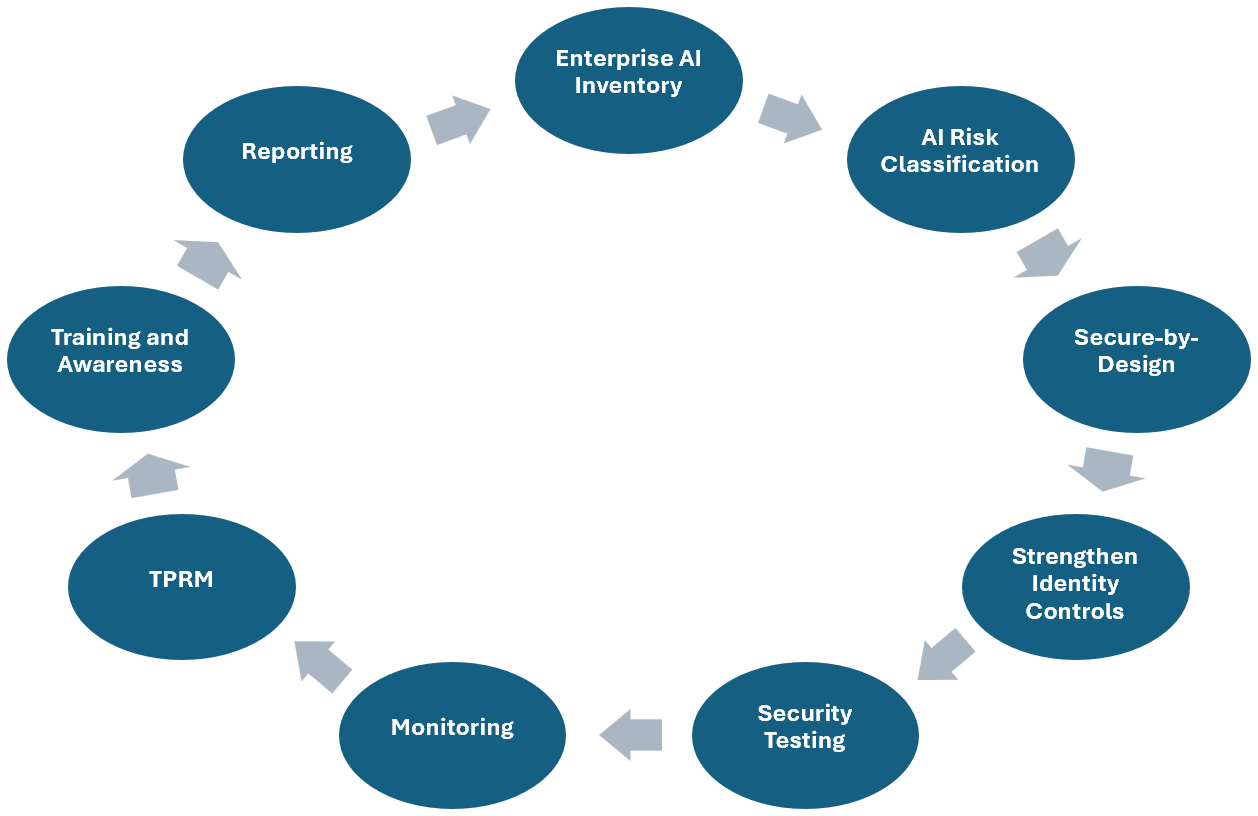
- Enterprise AI Inventory – Establish an enterprise AI inventory covering models, use cases, owners, data sources, vendors, risk ratings and regulatory scope.
- AI Risk Classification – Apply AI risk classification aligned to EU AI Act, GDPR, NIS2, DORA & sector-specific obligations.
- Secure-by-Design – Implement secure-by-design controls across the AI lifecycle: data collection, training, testing, deployment, monitoring and retirement.
- Strengthen Identity Controls – Strengthen identity controls for AI tools and agents, including least privilege, privileged access management and human-in-the-loop approvals.
- Security Testing – Use red teaming, adversarial testing, prompt injection testing, model evaluation and abuse-case simulation before production deployment.
- Monitoring – Integrate AI monitoring into SOC operations through telemetry, anomaly detection, model behaviour monitoring and threat intelligence.
- TPRM – Adopt contractual controls for AI suppliers, including audit rights, data usage restrictions, resilience requirements, breach notification and exit provisions.
- Training and Awareness – Educate employees on safe AI use, sensitive data handling, AI-generated phishing, deepfake verification and responsible prompting.
- Reporting – Report AI & cyber risk to board using business impact, resilience, compliance & customer trust metrics.
Future of AI security in Europe –
The future of AI security in Europe will be defined by speed, accountability and resilience. Attackers will increasingly use AI to automate discovery, deception & exploitation, while defenders will use AI to improve detection, vulnerability management, incident response and cyber resilience. The advantage will shift to organisations that can govern AI at enterprise scale while maintaining trust, compliance and operational control.
AI adoption in Europe is entering a new phase of innovation, security, regulation & resilience. Organisations that succeed will not be those that slow AI down, but those that adopt it with strong governance, secure engineering, trusted data, accountable ownership and continuous assurance. AI security will become a core pillar of digital trust, competitive advantage and regulatory confidence!
Author: Kavitha Srinivasulu
Company: TCS
Designation: Director Of Cyber Security & Data Privacy
About the Author:
Senior cyber risk and resilience executive with over 22 years of global leadership experience advising Boards and Executive Committees across Financial Services, Healthcare, Retail, Technology, and regulated industries. Delivered and led large-scale, regulator-driven cybersecurity, AI driven, PCI, and SOC transformations for Tier-1 banks, global healthcare organisations, and highly regulated enterprises operating across the UK, EU, USA, APAC, and ANZ. Trusted advisor to Boards, C-suite, regulators, and global enterprises, consistently delivering resilient, compliant, and scalable cyber operating models.