
Weaponizing Intelligence: How Threat Actors Exploit AI to Increase Risk
Artificial intelligence (AI) has become both a business accelerator and a significant driver of cyber risk. As organizations accelerate adoption, it becomes increasingly important to understand how AI is reshaping the threat landscape, introducing new vulnerabilities, and influencing the way we approach security, resilience, and risk management.
Threat actors are using generative AI, automation, deepfakes, autonomous agents, and AI-enabled malware to increase speed, scale, targeting precision, and deception across the attack lifecycle. At the same time, enterprise adoption of AI introduces new attack surfaces across models, prompts, data pipelines, APIs, identity layers, cloud infrastructure, third-party tools, and autonomous workflows.
Emerging Trends in the AI Threat landscape:
| Indicator | Current signal | Why it matters |
| AI-enabled adversary activity | Reported to have increased significantly year on year, with one major threat report citing an 89% increase in AI-enabled adversary operations. | Attackers are using AI to accelerate reconnaissance, credential theft, scripting, evasion, and social engineering. |
| Breakout speed | Average eCrime breakout time has been reported at 29 minutes, with the fastest observed breakout measured in seconds. | Defenders have less time to detect, contain, and respond before lateral movement or data theft begins. |
| Prompt and GenAI abuse | Threat actors have been observed injecting malicious prompts into legitimate GenAI tools and abusing AI development platforms. | Prompts, model interfaces, and AI platforms are becoming part of the enterprise attack surface. |
| Deepfake and AI phishing | Cybersecurity reporting shows increasing concern around deepfake-enabled impersonation, AI-generated phishing, vishing, and smishing. | Trust-based controls, approval workflows, and executive communications are increasingly vulnerable to synthetic identity abuse. |
| AI governance maturity gap | Many organisations are deploying AI faster than they are formalising AI security policies, inventories, red-teaming, and governance controls. | Shadow AI and unmanaged model usage increase the risk of data leakage, compliance failures, and uncontrolled decision-making. |
Key Risks and Challenges:
At the same time, we are mindful of potential risks, particularly those that could be exploited by threat actors. These may include vulnerabilities arising from increased exposure, potential gaps in controls, and the risk of misuse if appropriate safeguards are not fully in place. Addressing these areas proactively will be important to ensure we maintain a strong security posture.
Some of the emerging key risks are:

- Loss of control over sensitive Data: Unapproved AI usage within the organisation can expose confidential, personal, client, third party, regulated, or proprietary information.
- Weak model Governance: Lack of model inventory, ownership, lifecycle controls, approvals, risk classification and unmanaged discovery of data creates high risk exposure.
- Prompt Injections: Models may follow malicious instructions, produce insecure recommendations, or disclose restricted information.
- Identity and Access Risk: Dependency of AI systems access to enterprise data, APIs, and SaaS platforms, makes it very critical to manage the authentication and providing right level of access to the required forum.
- Supply chain Dependency: Using supplier Models, datasets, plug-ins, AI frameworks, and orchestration tools can introduce hidden vulnerabilities.
- Compliance and Regulatory Exposure: AI use may trigger obligations around privacy, explainability, fairness, accountability, security, auditability, and record keeping.
- Skills Gap: Security teams may be mature in traditional cyber controls but less experienced in AI red-teaming, model testing, adversarial ML, and AI governance.
How Threat Actors Weaponize AI Across the Attack Lifecycle?
| Attack stage | AI-enabled behaviour | Resulting Risk |
| Reconnaissance | During the reconnaissance phase, attackers are using AI to automate research on targets, including employees, suppliers, exposed systems, leaked credentials, and technology stacks. This significantly improves the speed and precision of targeting. | Faster and more accurate targeting. |
| Initial Access | For initial access, AI is enabling more sophisticated phishing campaigns, voice cloning, deepfake meetings, malicious prompt injections, and automated vulnerability discovery. This increases the likelihood of successful compromise. | Higher likelihood of successful compromise. |
| Execution and Persistence | In the execution and persistence stage, AI-assisted script generation, payload mutation, cloud exploitation, and automated privilege discovery allow attackers to operate with greater stealth while reducing manual effort. | Greater stealth and reduced manual effort for attackers. |
| Privilege Escalation | Privilege escalation is also being accelerated through automated identity mapping, token abuse, credential harvesting, and exploitation of excessive agent permissions, resulting in broader access to sensitive systems and data. | Broader access to sensitive systems and data. |
| Lateral Movement | AI-driven analysis of internal documentation, code repositories, tickets, and collaboration data. | Faster movement across business-critical environments. |
| Data collection and Exfiltration | Use of AI agents to identify high-value data, summarise stolen content, and evade monitoring. AI agents can identify high-value data, summarize stolen content, and evade monitoring controls, leading to accelerated loss of intellectual property, customer data, or regulated information. | Accelerated intellectual property, customer data, or regulated data loss. |
| Impact and Deception | Deepfake communications, automated extortion content, synthetic evidence, and misinformation campaigns. AI is being used to generate deepfake communications, automated extortion content, synthetic evidence, and misinformation campaigns, creating significant reputational, operational, legal, and financial risks. | Reputational, operational, legal, and financial damage. |
How to Protect the Data?
AI security is not only a technology issue, but an enterprise trust issue. It must bring together cybersecurity, privacy, legal, compliance, procurement, data governance, architecture, operations, and business leadership. Strong controls around identity, data, model integrity, third-party exposure, prompt security, agent permissions, and incident response will become essential foundations for responsible AI adoption.
- Adopt recognised frameworks: Align AI governance and security practices with NIST AI RMF, OWASP guidance for LLM and GenAI applications, ISO/IEC 42001, ISO/IEC 27001, secure software development practices, and relevant privacy regulations.
- Create an AI acceptable Use Policy: Define approved tools, prohibited data types, employee responsibilities, review requirements, and escalation routes.
- Maintain a central AI Asset Register: Record models, owners, business purpose, data sources, vendors, integrations, permissions, risk rating, and monitoring requirements.
- Implement secure-by-design AI Development: Include threat modelling, privacy impact assessment, security testing, code review, dependency scanning, model validation, and pre-production approval.
- Control third-party AI Exposure: Perform vendor risk assessment, contractual security clauses, data processing review, model transparency review, and exit planning.
- Secure RAG and Vector Databases: Validate source content, restrict retrieval scope, prevent sensitive data indexing, apply access control, and monitor indirect prompt injection risks.
- Use AI-specific Detection and Response: Extend SOC playbooks to cover AI abuse, anomalous prompts, unusual tool calls, model drift, data exfiltration, and agent misbehaviour.
- Educate Employees and Executives: Train users on AI phishing, deepfakes, safe prompting, data handling, shadow AI risk, and verification of sensitive requests.
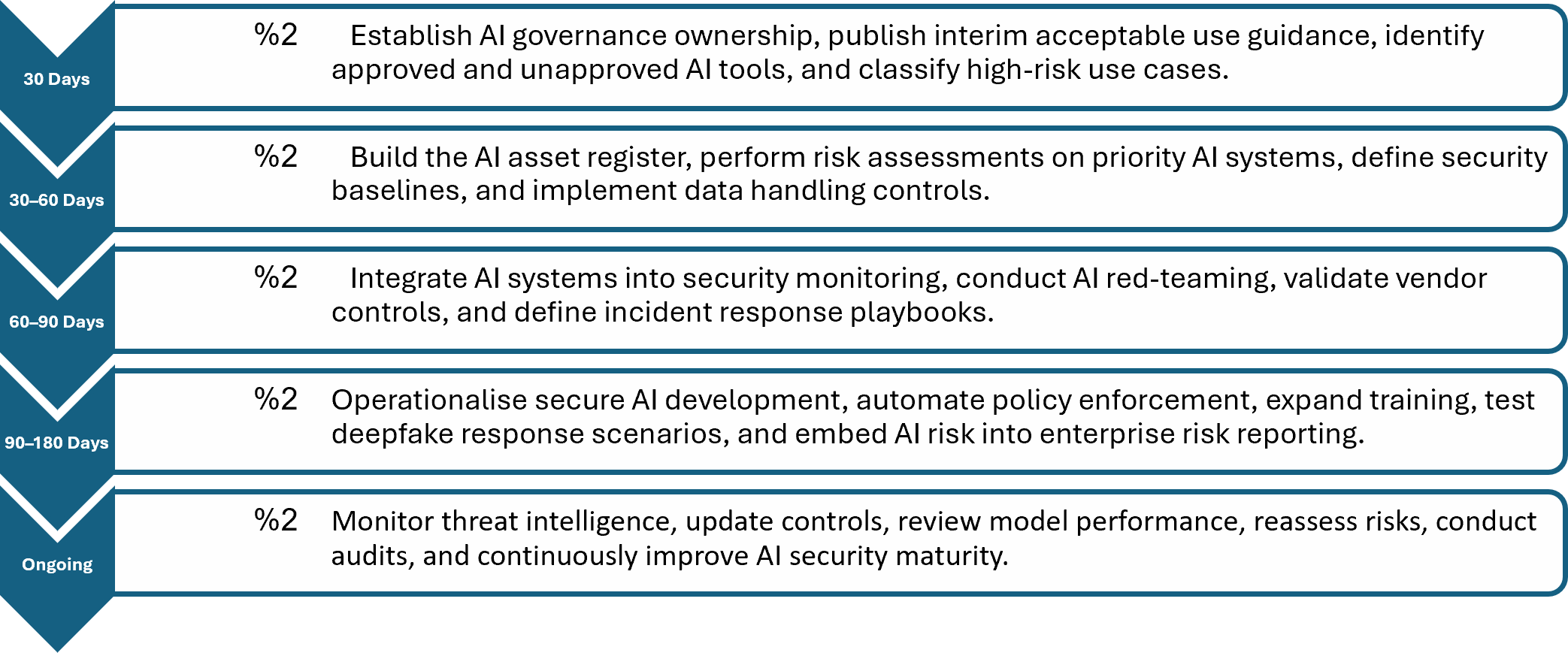
AI Implementation Roadmap:
The AI Implementation Roadmap provides a phased approach to building AI security maturity. It starts with establishing governance, acceptable use guidance, and visibility of AI tools, then progresses into asset management, risk assessment, security baselines, monitoring, red-teaming, vendor assurance, and incident response. Over time, the roadmap embeds secure AI development, policy automation, user awareness, deepfake readiness, and continuous improvement into enterprise risk management. This ensures AI adoption is controlled, secure, accountable, and resilient against evolving threats.
The way forward is clear as every organisation must build AI systems that are secure, explainable, resilient, monitored, and accountable. Embed security from design to deployment, verify high-risk actions through human oversight, educate users to recognise AI-enabled deception, and continuously test models against emerging adversarial techniques. In a threat landscape where intelligence itself is being weaponised, trust must be engineered and not assumed.
AI can be one of the strongest tools for business growth and cyber defence, but only when it is protected with the same discipline applied to any critical enterprise platform. The future belongs to organisations that innovate confidently, secure intelligently, govern transparently, and respond with speed. To secure the AI space, organisations must make security a core feature of AI, not as an afterthought.
Name – Kavitha Srinivasulu
Company – TCS
Designation – Director: Cyber Security & Data Privacy
Here is the summary about the Author- Senior cyber risk and resilience executive with over 22 years of global leadership experience advising Boards and Executive Committees across Financial Services, Healthcare, Retail, Technology, and regulated industries. Delivered and led large-scale, regulator-driven cybersecurity, AI driven, PCI, and SOC transformations for Tier-1 banks, global healthcare organisations, and highly regulated enterprises operating across the UK, EU, USA, APAC, and ANZ. Trusted advisor to Boards, C-suite, regulators, and global enterprises, consistently delivering resilient, compliant, and scalable cyber operating models.
Disclaimer to be added at the end of the article: “The views and opinions expressed by Kavitha in this article are solely her own and do not represent the views of her company or her customers.”