
Generative AI (Gen AI) represents a paradigm shift in organisational capability and traditional patterns, transforming how businesses operate, innovate, and compete in this evolving threat landscape and in the digital economy. From automating complex tasks to enabling creative problem-solving, Gen AI offers unprecedented opportunities but also accompanies novel risks that must be addressed with vigilance and foresight. As adoption accelerates globally, the conversation has shifted from “why innovate using AI?” to “how to innovate safely using AI?”
The rapid advancement of Gen AI technologies is reshaping the landscape for organisations across every industry, raising attention across all security controls and the existing maturity level of the organisation in facing Today’s uncertainties in managing risks. As AI tools become increasingly sophisticated, they offer unprecedented opportunities for innovation, efficiency, and competitive differentiation. However, their adoption also introduces new complexities, including evolving risk profiles, regulatory challenges, and the need for robust governance frameworks.
Organisations must not only harness Gen AI’s benefits but also proactively address ethical concerns, data privacy, and potential misuse. Let’s take some time to see how organisations are navigating in the era of Gen AI, exploring adoption patterns, emerging trends, associated risks, mitigation strategies, and industry best practices to ensure responsible and secure integration.
Current Position of Organizations on adopting Gen AI:
Organisations across the globe are embracing Gen AI at an increasing pace. Large enterprises are at the forefront, deploying Gen AI in areas such as automated content creation, data-driven insights, process optimisation, and personalised customer experiences. Mid-market and SMEs are catching up, leveraging cloud-based platforms to experiment with Gen AI tools.
- A recent survey indicates that 60% of Fortune 500 companies have piloted Gen AI applications, with use cases ranging from chatbots and virtual assistants to predictive analytics and marketing automation.
- In the public sector, agencies are exploring Gen AI to enhance service delivery, improve policy analysis, and modernise legacy systems.
- However, research underscores that only 35% of organisations have established comprehensive strategies for identifying and managing emerging Gen AI risks.
- Adoption is highest in finance, healthcare, retail, and technology, where Gen AI’s ability to process vast datasets and generate actionable insights yields significant competitive advantages.
- Global spending on Gen AI-related technologies is projected to reach £30 billion by 2027, signalling a compound annual growth rate (CAGR) exceeding 25%.
- In financial services, 70% of major banks report active deployment of Gen AI for fraud detection, risk modelling, and customer support, while healthcare sees 65% of providers leveraging AI for diagnostics and patient management.
- Retail and logistics sectors report 50% adoption, focusing on supply chain optimisation, inventory forecasting, and personalised shopping experiences.
While the promise of Gen AI is compelling, its adoption exposes organisations to a suite of new and evolving risks. These risks can be categorised as follows:
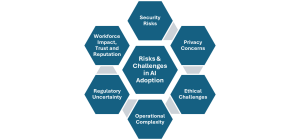
- Security Risks: AI systems often handle sensitive data, increasing the risk of data breaches, unauthorised access, and cyberattacks. Sophisticated adversaries may exploit vulnerabilities in model architecture or pipeline deployment.
- Privacy Concerns: Gen AI models trained on proprietary or personal data can inadvertently leak confidential information, violating privacy regulations such as GDPR or CCPA.
- Ethical Challenges: Bias in training datasets may lead to discriminatory outputs or reinforce harmful stereotypes. The lack of transparency in decision-making raises accountability issues.
- Operational Complexity: Integrating Gen AI with legacy systems, controlling model drift, and ensuring reliability require advanced IT capabilities. There are also risks of over-reliance on AI, which can erode human judgment and expertise.
- Regulatory Uncertainty: The regulatory landscape for Gen AI is in flux, with governments developing standards for responsible use, explainability, and safety.
- Workforce Impact: While Gen AI can enhance productivity, it may also automate roles, leading to workforce displacement, skill gaps, and organisational change management challenges.
- Trust and Reputation: Misuse or unintended consequences of Gen AI, such as the generation of deepfakes or misinformation, can erode stakeholder trust and damage brand reputation.
Approaches to Handle Risks: Strategies and Frameworks:
Forward-thinking organisations are deploying multi-layered strategies to mitigate the risks associated with Gen AI.
Key approaches include:

- Robust Risk Assessment: Continuously evaluate Gen AI systems for vulnerabilities through penetration testing, threat modelling, and scenario analysis.
- AI Governance and Ethics: Develop comprehensive policies governing AI usage, including ethical guidelines, transparency principles, and oversight mechanisms. Establish ethics review boards where appropriate.
- Privacy-By-Design: Incorporate privacy considerations from the outset, including data minimisation, anonymisation, and explicit consent management.
- Employee Training and AI Literacy: Upskill staff in AI fundamentals, risk awareness, and responsible usage, fostering a culture where employees are empowered to identify and escalate concerns.
- Technical Safeguards: Use explainable AI techniques to increase model interpretability and accountability. Monitor models post-deployment for drift, bias, and performance issues.
- Continuous Monitoring and Auditing: Implement real-time monitoring of Gen AI systems, regular audits, and adaptive risk management to respond to emerging threats.
- Stakeholder Engagement: Engage with regulatory authorities, customers, and partners to ensure alignment on responsible AI use and compliance with evolving standards.
Looking forward, organisations should continue to evolve their risk management frameworks to address the rapidly changing landscape of Gen AI. This includes anticipating new regulatory requirements, proactively adopting advancements in security technologies, and fostering cross-industry collaboration to share best practices and lessons learned. Generative AI stands at the frontier of organisational innovation, offering transformative benefits but demanding vigilant safeguards. By understanding the landscape, embracing comprehensive risk mitigation, and adopting proven best practices, organisations can unlock Gen AI’s full potential while protecting their assets, reputation, and people. As regulatory frameworks evolve and technologies mature, commitment to responsible AI will be the cornerstone of sustainable success in the age of Gen AI.
Kavitha Srinivasulu is a senior cyber risk and resilience executive with over 22 years of global leadership experience advising Boards and Executive Committees across Financial Services, Healthcare, Retail, Technology, and regulated industries. Delivered and led large-scale, regulator-driven cybersecurity, AI-driven, PCI, and SOC transformations for Tier-1 banks, global healthcare organisations, and highly regulated enterprises operating across the UK, EU, USA, APAC, and ANZ. Trusted advisor to Boards, C-suite, regulators, and global enterprises, consistently delivering resilient, compliant, and scalable cyber operating models.
Disclaimer:
The views and opinions expressed by Kavitha in this article are solely her own and do not represent the views of her company or her customers.