

In 2026, the UK insurance industry finds itself at the forefront of regulatory transformation, with a distinct emphasis on enhancing cyber resilience across its operations. This period is marked by the introduction of new rules and tightening of existing frameworks by regulatory authorities such as the Prudential Regulation Authority (PRA) and the Financial Conduct Authority (FCA), designed to address the mounting risks posed by increasing cyber-attacks and technological vulnerabilities.
Current Snapshot:
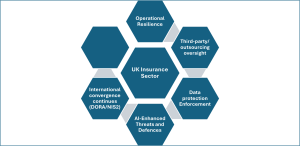
- Operational resilience: In March 2026, the FCA and PRA published final policy statements introducing a new operational incident reporting framework and new material third‑party reporting, including a single submission process across authorities. The regime is scheduled to apply from 18 March 2027, so 2026 is the main implementation year for insurers.
- Third‑party/Outsourcing Oversight: The third‑party register/notification expectations are designed to give regulators better visibility of dependencies (including ICT and critical suppliers), complementing the UK’s wider critical third‑party oversight approach.
- Data protection Enforcement: UK GDPR/ICO expectations continue to require robust security controls and the capability to notify the ICO within 72 hours for notifiable personal data breaches; this intersects directly with insurer incident response and customer communications planning.
- AI-Enhanced Threats and Defences:With phishing and malware using AI, insurers are investing in AI-powered defence tools while updating underwriting and claims systems to reflect this new threat landscape.
- International convergence continues (DORA/NIS2): Although the UK is outside the EU, insurers with EU entities or service dependencies will continue aligning operational resilience and incident reporting capabilities with DORA, while managing UK-specific reporting thresholds and timelines.
Insurers are being compelled not only to fortify their cybersecurity infrastructure, but also to embed resilience into their risk management strategies, incident response plans, and ongoing governance processes. These regulatory developments are shaping the way insurers approach digital risk, placing greater accountability on boards and senior management, requiring robust reporting mechanisms, and fostering collaboration with industry stakeholders. In turn, these measures aim to maintain public trust, protect policyholders’ data and assets, and ensure the sector’s stable contribution to the wider UK economy amidst a rapidly shifting cyber threat landscape.
2026 UK regulatory landscape affecting insurer cyber security:
1) FCA/PRA/Bank of England: Operational incident and Third‑party Reporting:
In March 2026, UK financial services regulators published final policy statements that standardise how firms report certain operational incidents and how they notify/report material third‑party arrangements. For insurers, this is best viewed as a cyber security change programme because the reporting triggers are closely tied to operational disruption, technology resilience, and supplier dependency.
- What changed in 2026: The FCA finalised PS26/2 (and published supporting finalised guidance), while the PRA published PS7/26, aligning key aspects of incident and third‑party reporting across regulators.
- Single submission / streamlined process: The regulators introduced a single reporting approach intended to reduce duplication for dual‑regulated firms and groups.
- Incident reporting: Firms must report qualifying operational incidents when defined thresholds are met, using a standardised process (with different information requirements for “standard” vs “enhanced” reporters).
- Third‑party reporting: Firms must notify regulators of new or significantly changed material third‑party arrangements and maintain an annual register using aligned templates. This extends beyond classic “outsourcing” to a broader set of third‑party services.
- Timing: The new framework is scheduled to apply from 18 March 2027, making 2026 the key mobilisation/implementation year for insurers (process design, tooling, governance, controls, and dry‑runs).
These reporting rules sit alongside the UK operational resilience framework (important business services, impact tolerances, mapping and scenario testing). Firms were expected to be able to remain within impact tolerances by 2025 and supervisory attention in 2026 is increasingly on the quality of mapping/testing evidence and the firm’s ability to detect, triage, and report disruptive incidents quickly and consistently.
2) ICO / UK GDPR: Security measures and Personal data breach notification:
For insurers, data protection remains one of the most immediate cyber‑regulatory drivers because cyber incidents frequently involve confidentiality and integrity risks to personal data (customers, claimants, employees, beneficiaries, and third parties).
- 72-hour notification clock: Where a personal data breach is notifiable, organisations must notify the ICO within 72 hours of becoming aware (where feasible).
- Individual communications: If the breach is likely to result in a high risk to individuals’ rights and freedoms, affected individuals must also be informed without undue delay.
- Breach record-keeping: Organisations must keep internal records of all personal data breaches (including those not reported to the ICO), supporting auditability and lessons learned.
- Operational implication for Insurers: Incident response must include an early, structured assessment of whether personal data is implicated, how many individuals are affected, and what harm scenarios apply (e.g., fraud, identity theft, sensitive claims data exposure).
3) UK Cyber Security and Resilience (NIS) Bill: expanding cross‑sector cyber duties:
The Cyber Security and Resilience (Network and Information Systems) Bill (factsheets updated March 2026) proposes significant amendments to the UK’s Network and Information Systems Regulations 2018. While the NIS regime is cross‑sector (focused on essential and certain digital services), insurers should track it closely because it can raise baseline security and reporting expectations across key suppliers (eg managed service providers, cloud/data centre services) and can change the broader incident reporting environment in the UK.
- Scope expansion: Proposals include bringing more technology and digital providers into scope (for example, managed service providers and certain data centre services), plus stronger supply-chain related measures.
- Faster, staged incident reporting: Proposed approach includes a light‑touch initial notification within 24 hours and a full report within 72 hours for specified incidents, with the NCSC informed alongside regulators.
- Why insurers should care: Even where an insurer is not directly regulated under NIS, their critical suppliers may be creating knock‑on expectations in contracts (notification clauses, evidence of controls, audit rights) and in incident-handling playbooks.
4) International and Group considerations (EU DORA / NIS2)
Many UK insurance groups operate in the EU or rely on EU-regulated entities and suppliers. In practice, 2026 programmes often aim to converge on a single set of operational resilience capabilities (taxonomy, severity classification, reporting workflow, third‑party inventory) that can satisfy both UK and EU expectations, while still handling jurisdiction‑specific triggers and timelines.
Key 2026 Regulatory Themes and Supervisory Focus Areas:
- From framework design to evidence of Resilience: Supervisors increasingly expect insurers to evidence that mapping and scenario testing are sufficiently severe, cover non-technology dependencies (people, premises, processes), and drive tracked remediation.
- Consistent Incident Taxonomy and Rapid triage: Operational incident reporting (and UK GDPR breach decisioning) pushes insurers toward clear severity thresholds, early impact assessment, and disciplined updates over the incident lifecycle.
- Third‑party Dependency Visibility and Concentration Risk: Maintaining an accurate inventory of material third parties, their sub‑outsourcing chains, and exit/transition plans becomes a board‑level topic, especially for core claims and policy administration platforms and key cyber security services.
- Testing expectations continue to Rise: More emphasis on realistic cyber scenarios (ransomware, destructive attacks, identity compromise), failover/fallback capability, and joint testing with critical suppliers.
- Governance and Accountability: Clearer ownership for operational resilience data (mapping artefacts, impact tolerance rationale, testing outcomes) and demonstrable challenge from the second and third lines.
- Customer communications Readiness: data breaches and service outages require “comms‑ready” playbooks (regulator notification, customer notification, brokers/TPAs, reinsurers, and counterparties) aligned with legal and contractual requirements.
Best Practices for Insurance Business:
- Incident Reporting: Map your current cyber/ops incident processes to the FCA/PRA operational incident framework; define which legal entities will be “standard” vs “enhanced” reporters and what data must be captured at each stage.
- Unify Classification: Align “operational incident” severity, “personal data breach” risk, and internal major incident categories so triage decisions are consistent and auditable.
- Build Third‑Party Register: Create/refresh a single inventory of material third‑party arrangements (including non‑outsourcing technology dependencies), with ownership, update cadence, and evidence sources.
- Contract Uplift: Update key supplier contracts for (a) timely incident notification, (b) cooperation in investigations and regulator engagement, (c) audit/assurance rights, (d) sub‑outsourcing transparency, and (e) tested exit/transition support.
- Scenario Testing: Prioritise severe‑but‑plausible cyber scenarios that plausibly breach impact tolerances; include critical third parties in joint exercises; track remediation to closure.
- Regulatory Reporting: Define who submits what, through which portal/process, with 24/7 coverage, draft templates, and rehearsal (“dry run”) playbooks.
- Metrics and MI: Ensure board and executive MI links incidents, vulnerabilities, testing outcomes, and third‑party risks to important business services and impact tolerances.

The UK regulatory direction in 2026 continues to shift cyber resilience in insurance from a technology concern to a board-owned component of operational resilience. Expectations from the FCA and PRA increasingly converge on outcomes: firms must be able to prevent, withstand, respond to, and recover from cyber disruption within defined impact tolerances, supported by credible scenario testing and demonstrable lessons learned. At the same time, growing scrutiny of outsourcing and third‑party risk raises the bar on supplier due diligence, contract provisions, ongoing monitoring, and exit/contingency planning, particularly where cloud and managed security services are critical in today’s threat landscape.
Disclaimer :
“The views and opinions expressed by Kavitha in this article are solely her own and do not represent the views of her company or her customers.”
Kavitha Srinivasulu – Senior cyber risk and resilience executive with over 22 years of global leadership experience advising Boards and Executive Committees across Financial Services, Healthcare, Retail, Technology, and regulated industries. Delivered and led large-scale, regulator-driven cybersecurity, AI-driven, PCI, and SOC transformations for Tier-1 banks, global healthcare organisations, and highly regulated enterprises operating across the UK, EU, USA, APAC, and ANZ. Trusted advisor to Boards, C-suite, regulators, and global enterprises, consistently delivering resilient, compliant, and scalable cyber operating models.