
AI adoption is fundamentally reshaping cybersecurity compliance, elevating it from a predominantly deterministic, point-in-time assessment into a continuous, lifecycle-driven discipline. As organisations deploy systems that learn, generate, infer and act autonomously, compliance must evolve to ensure ongoing trust, accountability and resilience across the entire AI ecosystem. While traditional cybersecurity controls remain essential, they are no longer sufficient on their own. Effective governance now requires extending oversight to AI models, training and retrieval data, prompts, agents, third-party foundation models, AI-driven decisions and the dynamic behaviours that emerge as these systems evolve. The objective is not only to maintain compliance, but to proactively manage risk, demonstrate responsible AI practices and enable sustainable innovation at scale.
AI compliance should not be established as a separate certification project. It should be integrated with enterprise risk management, information security, privacy, model risk, product governance, operational resilience, legal compliance and internal audit to achieve business resilience in the emerging threat landscape.
1. Adoption is moving from experimentation to scale: 30% of cybersecurity teams already use AI-enabled security tools, while another 42% are evaluating or testing them—putting 72% of teams on an active AI adoption path.
2. Large enterprises are leading: 37% of organisations with more than 10,000 employees have integrated AI into cybersecurity operations, compared with 20% among organisations with 500–2,499 employees.
3. Operational value is already visible: 70% of adopters report a positive impact on cybersecurity-team effectiveness, with the strongest near-term use cases in network monitoring and intrusion detection (60%), endpoint protection and response (56%), and vulnerability management (50%).
4. AI materially improves cyber resilience: Organisations using security AI and automation extensively reduced average breach costs by US$1.9 million and shortened the breach lifecycle by 80 days as per IBM, Cost of a Data Breach Report 2025.
5. AI use is now pervasive across the enterprise: 90% of organisations use generative-AI applications and 98% use applications containing generative-AI features; however, direct GenAI use is concentrated among 4.9% of users.
6. Data exposure is rising faster than controls: Data sent to GenAI applications through prompts and uploads increased more than 30-fold in one year, expanding exposure of source code, regulated data, intellectual property and secrets.
7. AI governance remains the critical gap: 63% of breached organisations either lack an AI governance policy or are still developing one; among organisations with a policy, only 34% regularly audit for unsanctioned AI use.
AI is already delivering measurable improvements in detection, response, productivity and breach economics, but adoption is outpacing governance. The board-level priority is to scale approved AI use while enforcing access controls, data-loss prevention, model and vendor assurance, continuous monitoring, workforce training and accountable human oversight.
Regulatory and Industry Standards Snapshot:
Regulators and industry standards increasingly expect organisations to treat AI as an enterprise risk domain governed across its full lifecycle, not simply as a technology deployment. The required level of control should be proportionate to the AI system’s use, data sensitivity, autonomy and potential impact on people, critical services and business decisions.
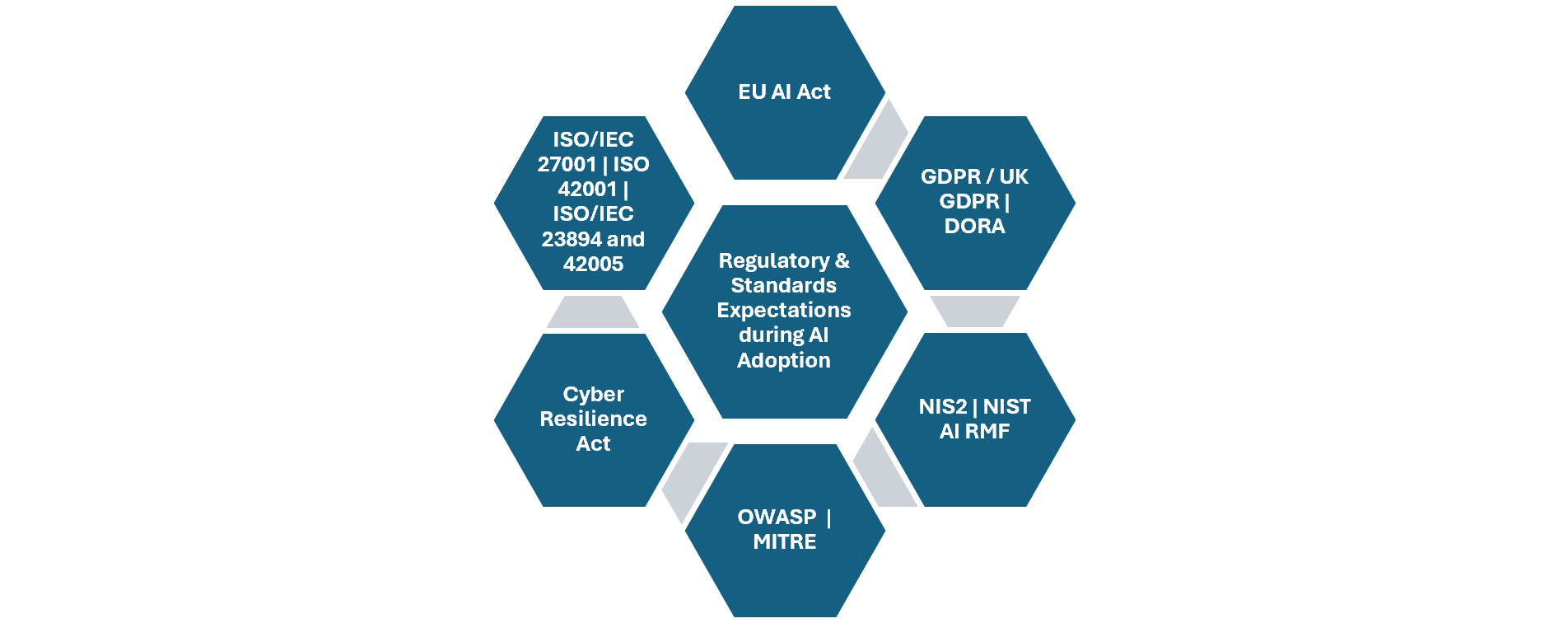
A quick overview of regulatory and standard expectations –
| Framework / Regulation | Role in the Control Stack | AI-Relevant Expectations |
| EU AI Act | Binding, risk-based AI regulation for providers, deployers and other actors in the EU market. | Risk classification, prohibited practices, AI literacy, data governance, technical documentation, logging, human oversight, accuracy, robustness, cybersecurity, post-market monitoring and incident reporting. |
| GDPR / UK GDPR | Personal-data and automated-decision governance. | Lawful basis, transparency, minimisation, DPIAs, privacy by design, data-subject rights, processor oversight and controls for solely automated decisions. |
| NIS2 | Cyber risk management and incident reporting for essential and important entities. | Governance accountability, supply-chain security, vulnerability handling, business continuity, cryptography, access control and rapid incident notification. |
| DORA | Digital operational resilience for EU financial entities and critical ICT providers. | ICT risk management, resilience testing, incident reporting, third-party concentration risk and contractual oversight of AI/cloud services. |
| Cyber Resilience Act | Security obligations for products with digital elements. | Secure-by-design lifecycle, vulnerability management, product updates, technical documentation and reporting—relevant where AI is embedded in products. |
| ISO/IEC 27001 | Certifiable information security management system. | Foundational governance, asset, access, supplier, logging, incident and secure-development controls on which AI controls can be overlaid. |
| ISO/IEC 42001 | Certifiable AI management system. | AI policy, objectives, roles, impact assessment, lifecycle controls, third-party management, monitoring and continual improvement. |
| ISO/IEC 23894 and 42005 | AI risk management and AI system impact assessment. | Structured identification, analysis, treatment and monitoring of AI risks and impacts. |
| NIST AI RMF | Voluntary operational framework. | Govern, Map, Measure and Manage trustworthy-AI risks; the Generative AI Profile extends this for GenAI-specific risks. |
| NIST CSF 2.0 | Enterprise cybersecurity outcomes. | Govern, Identify, Protect, Detect, Respond and Recover outcomes applied to AI assets and AI-enabled threats. |
| NCSC Secure AI Development / UK AI Cyber Security Code | Secure-by-design guidance and baseline practices. | Secure design, development, deployment, operation, supply chain, documentation and lifecycle maintenance. |
| OWASP Top 10 for LLM Applications | Application-level threat and testing reference. | Prompt injection, sensitive-information disclosure, supply-chain weaknesses, data/model poisoning, improper output handling and excessive agency. |
| MITRE ATLAS | Adversarial threat-knowledge base for AI systems. | Threat modelling, detection engineering, red teaming and attack-path analysis for machine-learning systems. |
Emerging AI Risks and Compliance Challenges:
• Prompt Injection & Instruction Manipulation: Untrusted content overrides intended behaviour or induces unauthorised actions.
• Data and Model Poisoning: Compromised training, tuning or retrieval data changes output integrity.
• Sensitive-Data Leakage: Personal, regulated, confidential or copyrighted information appears in prompts, training data, logs or outputs.
• Model Theft and Extraction: Weights, system prompts, proprietary behaviour or intellectual property are copied through direct compromise or repeated querying.
• Insecure output Handling: Generated code, commands or content are consumed by downstream systems without validation.
• Excessive Agency: AI agents receive permissions, tools or autonomy beyond the minimum required.
• Hallucination & Unreliable: Probable but incorrect outputs create operational, legal or safety impacts.
• Adversarial Examples and Evasion: Crafted inputs cause misclassification or bypass controls.
• AI Supply-chain Compromise: Risks enter through models, datasets, plug-ins, libraries, APIs, vector databases or hosting providers.
• Model drift and Performance Decay: Accuracy, fairness, safety or security decline as data and operating conditions change.
• AI-enabled Attacks: Adversaries use AI to scale reconnaissance, social engineering, malware adaptation and vulnerability exploitation.
Target Continuous Assurance Compliance Model:
The AI Security Adoption Continuous Assurance Model enables organisations to scale AI securely and responsibly by embedding continuous, risk-based governance across the full AI lifecycle—from discovery and assessment through validation, monitoring, and improvement. It gives leaders real-time visibility into AI assets, control effectiveness, regulatory exposure, model behaviour, and emerging threats, replacing point-in-time approvals with evidence-led oversight that accelerates trusted innovation, strengthens accountability, and enhances enterprise resilience.

• Discover: Maintain an inventory of AI use cases, models, data, owners, vendors, and dependencies.
• Assess: Classify business criticality & evaluate security, privacy, safety, regulatory, and third-party risks.
• Govern: Apply risk-tiered policies, accountable ownership, approval gates, and human oversight.
• Validate: Test data lineage, access controls, model behaviour, prompt-injection resistance, leakage, bias, and recovery readiness.
• Monitor: Track model drift, misuse, anomalous access, data exposure, vulnerabilities, and control exceptions in near real time.
• Improve: Trigger remediation, retraining, control tuning, lessons learned and required risk acceptance.
Industry Best Practices:
• Govern one AI Portfolio: Require registration before procurement, experimentation or production use; use technical discovery to detect unregistered services.
• Apply Risk-tiered Gates: Scale documentation, testing, oversight and approval to the use case’s regulatory and business impact.
• Build secure-by-design pipelines: Integrate data validation, software composition analysis, model scanning, policy checks, evaluation and signed deployment artefacts into CI/CD and MLOps.
• Use an AI Gateway: Centralise approved model access, identity, prompt/output filtering, rate limits, logging, routing and policy enforcement.
• Separate Data and Duties: Isolate training, tuning, evaluation and production datasets; restrict who can change models, prompts, policies and release decisions.
• Constrain Agents: Use allow-listed tools, scoped tokens, transaction limits, sandboxing, approval checkpoints and deterministic fallbacks.
• Test Continuously: Maintain regression suites for security, privacy, bias, robustness and harmful outputs; retest after material changes.
• Design Human Oversight: Define when users must review, override, stop or escalate AI output; train them to recognise automation bias.
• Preserve evidence by Design: Generate audit-ready records automatically from engineering and operational workflows.
• Integrate the Three lines: First-line product and engineering ownership, second-line risk and compliance challenge, and third-line independent assurance.
• Prepare for Failure: Maintain kill switches, rollback, alternate providers, manual procedures and crisis communications.
• Track Regulatory Change: Assign jurisdiction owners and update obligation-to-control mappings as laws, guidance and standards evolve.
The reality is that AI adoption is already moving faster than most governance, technology and regulatory operating models. Organisations cannot wait for complete regulatory certainty, perfect inventories or risk-free technology before acting. Nor can they rely on annual audits, policy documents or legacy controls to manage systems that change continuously, depend on external providers and can influence decisions at digital speed.
Continuous assurance comes from a defined compliance model; it is a business-resilience capability. It converts regulatory obligations into operational discipline, produces evidence as work happens and gives leadership timely insight into whether AI remains safe, lawful and aligned with organisational values. The organisations that succeed will not be those that predict every future rule or threat. They will be those that can sense change early, respond decisively, learn continuously and demonstrate trust through measurable action.
Name – Kavitha Srinivasulu
Company – Persistent Systems
Designation – Vice President: Field CISO
About the Author-
Senior Cybersecurity and Risk Advisory executive with 23+ years of global leadership experience advising Boards and Executive Committees and leading regulator-driven transformations for Tier-1 banks and global enterprises across the UK, EU, USA, APAC and ANZ. Trusted C-suite advisor who integrates risk, security engineering and digital transformation to enable secure AI security adoption, strengthen resilience and build lasting stakeholder trust.
Disclaimer:
“The views and opinions expressed by Kavitha in this article are solely her own and do not represent the views of her company or her customers.