

The Europe Cyber Resilience Act makes product cybersecurity a strategic business issue for organisations serving the EU market. Compliance is the baseline and it’s very important to protect the market access, strengthen customer trust and build products that remain secure and supportable throughout their lifecycle. A resilience-led approach brings security into product investment and commercial strategy rather than treating it as a final compliance exercise.
The board’s central decisions are where to invest, which product risks to prioritise and how to fund long-term security support. Clear executive accountability and shared capabilities across engineering, supplier assurance and vulnerability response can reduce fragmented effort and strengthen the organisation’s ability to manage disruption. Success should be judged by defensible market-readiness decisions and sustainable product resilience, not by the volume of compliance documentation.
Regulatory expectations in Europe:
The EU Cyber Resilience Act, Regulation (EU) 2024/2847, establishes cybersecurity requirements for products with digital elements placed on the EU market. Its strategic significance extends beyond conformity paperwork: it connects secure product design, supply-chain visibility, vulnerability handling and sustained customer support into a lifecycle obligation.
For businesses, CRA readiness should therefore be a product-transformation programme jointly owned by leadership, engineering, security, legal, procurement and customer operations. Organisations outside the EU also need to assess their obligations when their products enter the EU market. Some of the key focus areas include:

- Regulatory Readiness: Understand applicability, demonstrate conformity and establish the required reporting and support processes.
- Business Resilience: Reduce avoidable product-security exposure, maintain recovery and update capabilities, and make informed decisions when vulnerabilities emerge.
- Commercial Value: Use credible lifecycle evidence and transparent support commitments to strengthen customer confidence, without presenting compliance as a guarantee against incidents.
- Leadership Priority: Treat market access, secure engineering and post-market support as one operating model. Assign an accountable and product-level owners, with resources extending beyond launch.
The CRA generally applies to hardware and software products with digital elements made available on the EU market where their intended or foreseeable use includes a direct or indirect logical or physical data connection to a device or network. Assess each product and business role separately. Manufacturers carry the principal design & lifecycle duties, while importers & distributors have their own verification & cooperation responsibilities.
Check statutory exclusions and interaction with sector legislation, including medical devices and certain automotive, aviation and marine equipment. Free and open-source software supplied outside a commercial activity is excluded, but open-source use within a commercial product does not exempt the manufacturer. Open-source software stewards have a distinct regime.
Core product and lifecycle requirements
| Regulatory Expectations | Practical evidence or operating capability |
| Cybersecurity risk assessment and essential requirements | Product-specific risk assessment; secure-by-design and secure-by-default controls; testing and documented treatment of relevant risks. |
| Vulnerability handling and component visibility | A documented handling process coordinated disclosure policy & machine-readable software bill of materials covering at least top-level dependencies. |
| Support and security updates | Define and communicate the support period. It is generally at least five years, unless expected product use is shorter. Establish timely remediation and secure update distribution. |
| Conformity and market access | Technical documentation, the applicable conformity procedure, EU declaration of conformity and CE marking. CE marking is not necessarily third-party certification. |
| Post-market reporting and corrective action | Detect reportable events, meet notification deadlines, inform affected users as required, and coordinate fixes and authority cooperation. |
Key Priorities:
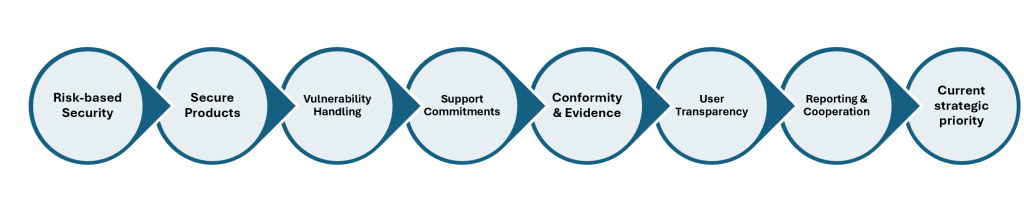
- Risk-based Security: Conduct and document cybersecurity risk assessments and address applicable essential requirements throughout design, development, production and maintenance.
- Secure Products: Address requirements such as secure-by-default configuration, protection against unauthorised access, confidentiality and integrity, data minimisation, attack-surface reduction and resilience, as applicable to the product.
- Vulnerability Handling: Identify & document components & vulnerabilities, maintain a software bill of materials in the required form, operate with vulnerability disclosure policy, provide security updates & remediation process.
- Support Commitments: Determine and communicate the support period under the CRA rules. The general minimum is five years unless expected product use is shorter.
- Conformity & Evidence: Maintain technical documentation, complete applicable conformity assessment, issue an EU declaration of conformity and apply CE marking.
- User Transparency: Provide required instructions and security information, including appropriate vulnerability contact and support information.
- Reporting & Cooperation: Establish reporting processes for actively exploited vulnerabilities and severe incidents affecting product security and cooperate with the relevant authorities.
- Current strategic priority: Separate reporting readiness, which already requires attention under the published timetable, from the broader product-conformity programme leading to December 2027.
Milestones and Reporting Readiness:
| Milestone | CRA Timelines | Planning implication |
| Entry into force | 10 December 2024 | Use enacted regulation as the baseline for product and role mapping. |
| Reporting obligations apply | 11 September 2026 | Confirm applicability and test reporting arrangements now. |
| Main obligations apply | 11 December 2027 | Complete applicable product assurance & conformity preparations. |
Relationship to other European obligations:
CRA readiness should connect with, but not be confused with, NIS2, GDPR and relevant sectoral requirements. CRA focuses on product cybersecurity; NIS2 addresses cybersecurity risk management and reporting for covered entities; GDPR governs personal-data protection. A single event may trigger separate duties. Use a shared triage process with distinct legal decisions, clocks and evidence records.
Risks and challenges in aligning to the CRA –
Non-compliance can expose organisations to corrective measures, restrictions on market availability and penalties. The commercial impact can extend beyond enforcement to procurement exclusion, customer distrust, emergency remediation and product withdrawal. Avoid treating a fine estimate as the sole measure of risk.
| Challenge | Potential business consequence | Recommended response |
| Unclear scope or product classification | Wrong conformity route, late redesign or delayed market access. | Maintain a product and role register with documented legal & engineering decisions. |
| Legacy architecture and hard-to-update devices | Costly remediation and prolonged exposure across the installed base. | Prioritise by product risk; test secure updates, rollback and safe field deployment. |
| Opaque dependencies & supplier support gaps | Slow impact assessment or fixes when component looks vulnerable. | Validate SBOM completeness, supplier obligations and replacement options. |
| Fragmented evidence & uncertain capacity | Late assurance bottleneck repeated testing or documentation work. | Map requirements to release evidence, confirm assessor needs & availability early. |
| Weak reporting and response coordination | Missed notification clocks, inconsistent communication or unsafe emergency fixes. | Establish a product-security response team, legal escalation and timed exercises. |
| Underfunded support commitments | A mismatch between lifecycle promises, technical capacity and product economics. | Fund maintenance and customer support alongside development; document end-of-support decisions. |
| Overlapping regulatory obligations | Duplicated work or gaps between product-security, entity-security and privacy processes. | Share evidence where appropriate, keeping separate legal triggers & duties visible. |
CRA Alignment and Readiness:
Assess readiness across three connected domains including product engineering, supply-chain governance, assurance and response. Strength in enterprise IT security does not automatically establish product-level CRA conformity, however, an organisation must demonstrate how its shipped products remain secure and supported. Some of the industry best practices can help to support CRA readiness but does not by itself demonstrate legal conformity or replace the applicable assessment. So, every organisation must raise few questions within their portfolio to understand the industry context and prepare for implementing CRA.
The following approaches support CRA readiness –
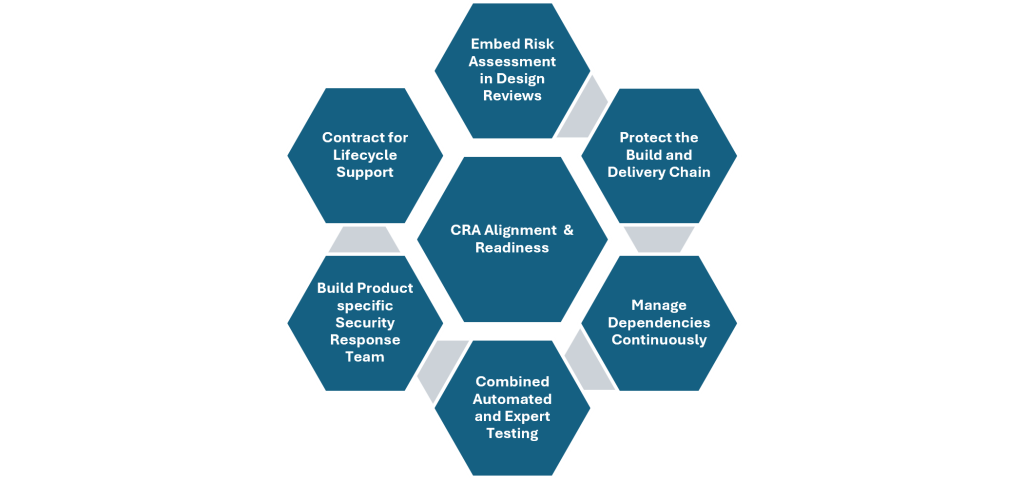
- Embed Risk Assessment in Design Reviews: Maintain threat models relevant to intended & reasonably foreseeable use. Review privileges, interfaces, sensitive data & availability risks before release.
- Protect the Build and Delivery Chain: Use controlled source access, protected signing credentials, reproducible evidence where feasible, and authenticated update distribution. Test recovery and rollback so urgent patches do not create unacceptable field risk.
- Manage Dependencies Continuously: Generate release-specific machine-readable SBOMs, verify their accuracy and link components to vulnerability intelligence. Use exploitability context to prioritise action rather than treating every scanner finding as equivalent.
- Combined Automated and Expert Testing: Integrate code, dependency & configuration checks with product-appropriate penetration testing & manual review. Record findings, remediation and decisions.
- Build Product specific Security Response Team: Rehearse actively exploited vulnerabilities & severe incidents, including notification clocks, supplier/customer communication & secure patch deployment.
- Contract for Lifecycle Support: Clarify supplier notification duties, component support, vulnerability cooperation & remediation. Do not rely on contractual assurances without technical verification.
CRA readiness is a strategic product transformation, not a one-off regulatory exercise. Sustainable alignment brings together legal scope, secure engineering, supplier assurance, funded support, operational reporting and defensible evidence. This combination can strengthen European market access while making products easier to maintain and organisations better prepared to absorb disruption.
The immediate leadership priority is to validate the reporting capability and establish a product-level, funded route to the December 2027 obligations. The longer-term opportunity is to turn those foundations into continuous assurance: a repeatable ability to know what is deployed, understand what is vulnerable, act promptly and demonstrate trustworthy decisions.
Name – Kavitha Srinivasulu
Company – Persistent Systems
Designation – Vice President: Field CISO
“The views and opinions expressed by Kavitha in this article are solely her own and do not represent the views of her company or her customers.”